 Dungeon Merlin
Christopher Alexander’s books The Timeless Way of Building and A Pattern Language are two incredible books. In them, Alexander proposes that there’s a “natural” way of structuring the built environment such that humans enjoy inhabiting it. This way is “from the bottom up,” in dialogue between the builder, the people living in a place, and the place itself.
In designing a building this way, the people involved will naturally gravitate toward—and discover—so-called “patterns” that repeat across buildings and serve a particular purpose when used (e.g., a way of arranging windows in a room can lead to certain features that make the room enjoyable to use). The ultimate goal is to design in a way that “feels right” and is “beautiful,” though Alexander would deny that this is a good description of what is achieved when using this timeless way of building. He says what you achieve is really “the quality without a name.” In this sense, his work is more an attempt at a philosophy of aesthetics. Basically, Alexander is the original vibe-builder.
This is, of course, a very simplified version of his arguments. And really, his whole thesis can be a bit muddy at times—possibly the reason it’s had a larger impact outside of architecture than within. Most famously, perhaps, in object-oriented programming, where “Design Patterns” are a pervasive, if controversial, subject.
And while I can certainly see criticisms of these early works by Christopher Alexander, I absolutely love them, and I think applying them to things can be very useful—and even fun.
So here’s my first attempt at applying them to adventure design. It’s only a thought experiment for now, so there will only be three attempts at patterns in total. Call it a “seed” for a larger language.
Structure
Patterns in A Pattern Language follow a certain structure that I’ll try to adhere to here as well:
- Name
- Zero to three stars representing the author’s confidence that the pattern is actually “true”
- Image
- Problem Statement
- Discussion
- Solution
- “Links” to later patterns
Patterns form an interlinked graph of nodes and connections you can follow to build up a site pattern by pattern. In this way, each application of the pattern language you’re using will lead to a different combination of a subset of patterns from the whole language.
Also, the “A” in A Pattern Language—instead of “The”—is very deliberate. There might be different languages by different people.
GLOG Patterns
I think it would be amazing if other people tried their hand at patterns that could then be combined into a language—kind of like what the Goblin Laws of Gaming did for a system of rules.
Patterns
1. Usability at the Table ★★★
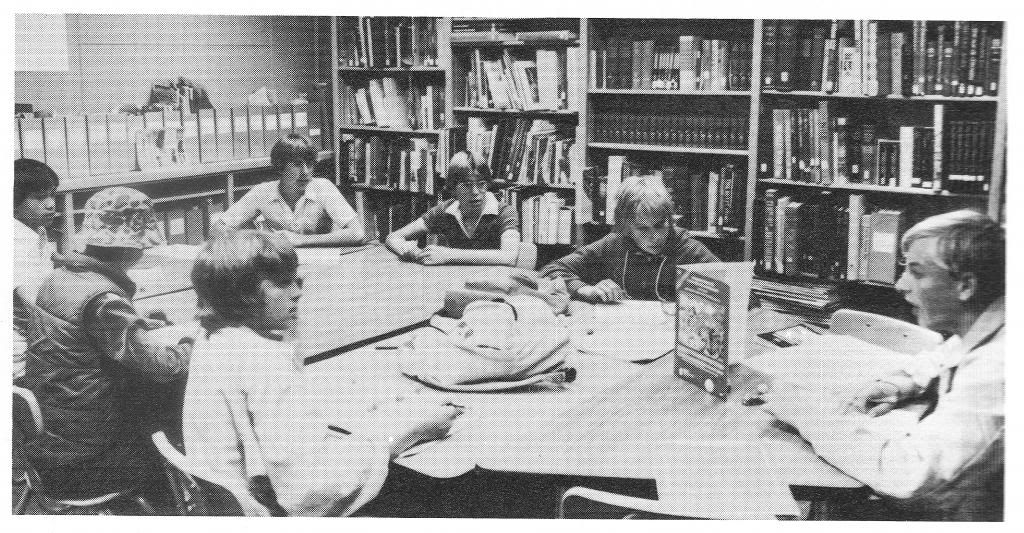
Image source: This post by 2 Warps to Neptune
Adventures are written scenarios for the GM to present to their players, and for the players to interact with. The amount of play is limited by the amount of time required for it to happen. In addition to the playtime itself, there is time the GM needs to invest to prepare an adventure for play. So it’s essential to make them require as little additional markup as possible to be used during a session.
Adventures written in lush prose require too much reading from the GM during play. During a session, the GM will probably not need the information in the expected order, and they will be under pressure to maintain momentum. We know a lot about how to make a text more parsable: hierarchy, bold text, bullet points, supporting visuals, etc. Adventures should use these elements to lighten the GM’s load.
Therefore:
Use information architecture and visual design to make the text of the adventure easily parsable. Highlight important information that the reader will need again and again or at a glance, cut as many unnecessary elements as possible, and always keep the reader and their situation at the table in mind when designing the adventure.
See also: Bold Text (2)
2. Bold Text ★★
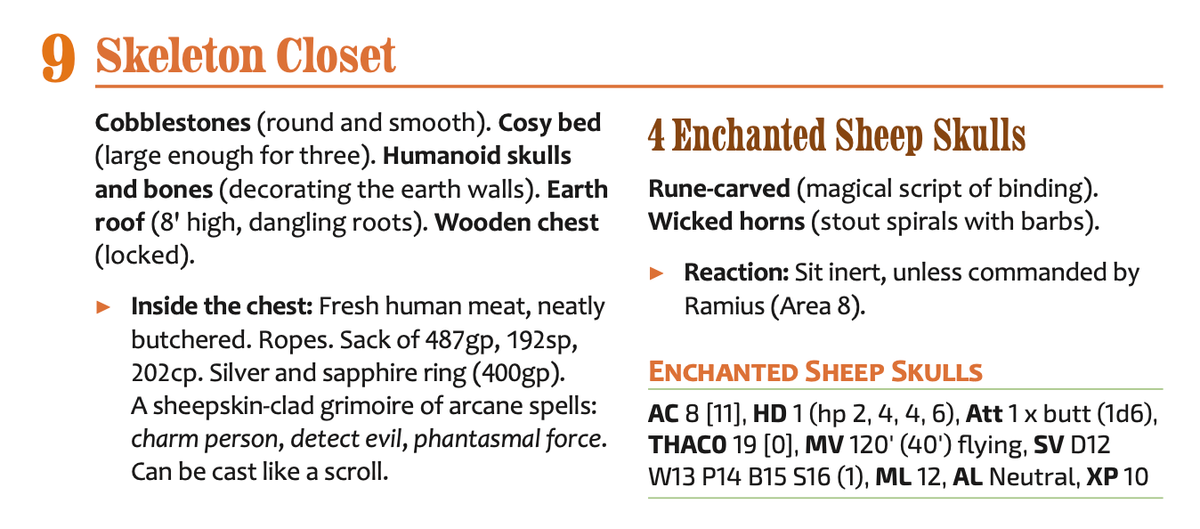
Image source: This adventure by Necrotic Gnome
There’s information inside paragraphs that you will need to reference multiple times, even after reading it. This often corresponds to the most important information for understanding what the paragraph is about. The easier this is to see at a glance, the less time it will cost to reference during play—maintaining momentum and freeing mental capacity for creative thinking.
Hundreds of years of trial and error—and many studies—have shown that people read elements of a text in a predictable order. This order is shaped by the visual hierarchy of the elements: the larger and higher-contrast an element is, the earlier it will be read.
Therefore:
Use bold text to highlight the most important parts of a paragraph. When in doubt, highlight entities or concepts—such as the names of characters or factions, or the material composition of objects—that the paragraph is about.
n. Multiple Entries ★
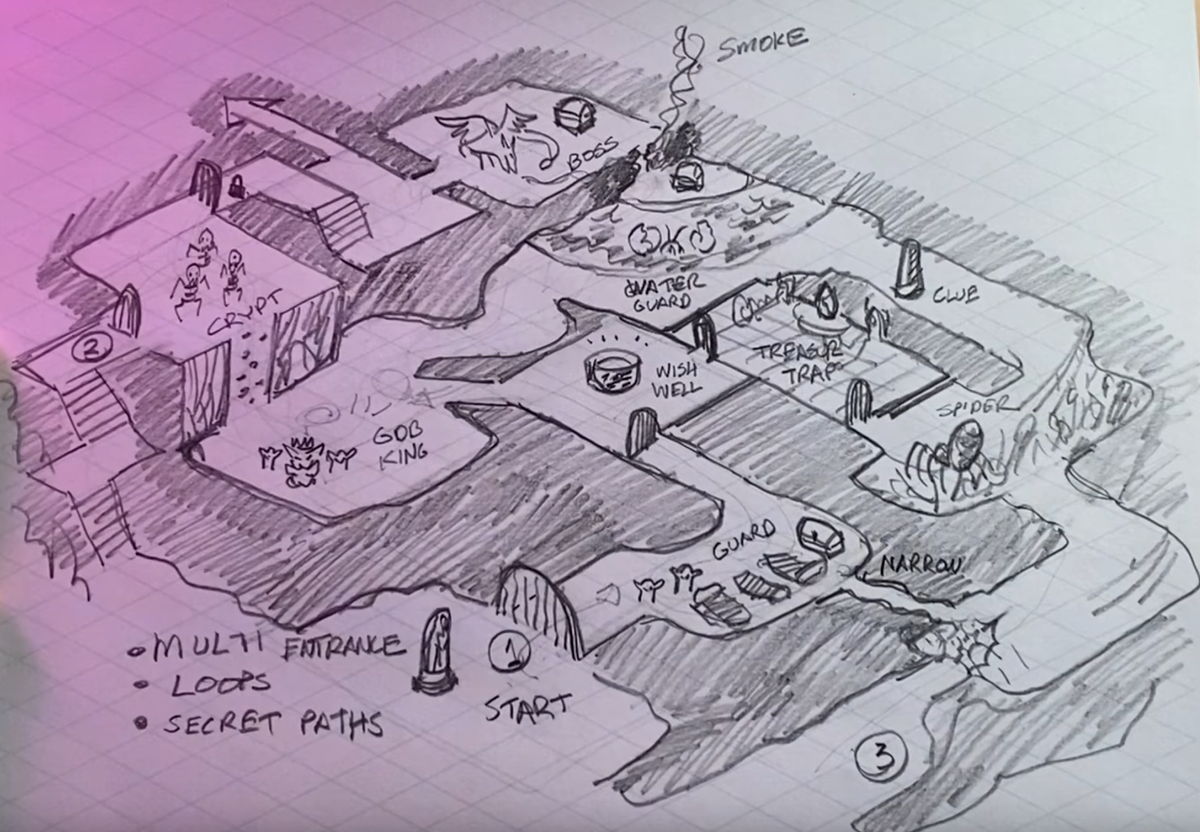
Image source: This video by Map Crow
How you enter a given encounter has a huge impact on the possibilities for how that encounter could play out. Multiple entries increase the possibility space for situations and make them less predictable for both the GM and the players.
As noted in Meaningful Choice (m), the goal in designing an adventure is often to maximize the number of meaningful decisions players make during play—where “meaningful” means that choosing one option over another leads to recognizably different outcomes.
When players engage with an encounter, the first choice they often face is how to enter it. This decision can lock or unlock certain options later in the sequence of events, magnifying its impact on the shape of the encounter. Providing multiple, distinct ways to enter a space gives players an immediate sense of agency and creates more varied play outcomes.
When applied to dungeons, this was part of the design philosophy of the late Jennell Jaquays. When applied to any kind of encounter, it is reminiscent of what Justin Alexander calls the Three Clue Rule.
Therefore:
Provide multiple entries to rooms, situations, and encounters. Make them recognizably different from each other, with each path locking and unlocking certain follow-up options depending on which the players choose.